Product/ ·4 min read
Put Craft Back Into the Center
Product Craft /Product Strategy /AI /Leadership
Software delivery has long prioritized release speed over feature completion. The challenge is what gets left behind.
Every product codebase accumulates half-finished initiatives: an onboarding flow labeled acceptable for launch three years ago that was never revisited, a notification system that functions technically while causing daily friction, or a dashboard built for an initial hypothesis before the team pivoted.
This pattern stems from fifteen years of established industry habits: ship fast, validate early, and move to the next item on the roadmap. Over time, minimum viable products evolved from a testing method into a permanent production standard.
AI is now rewriting the underlying economics of product development.
The MVP bargain
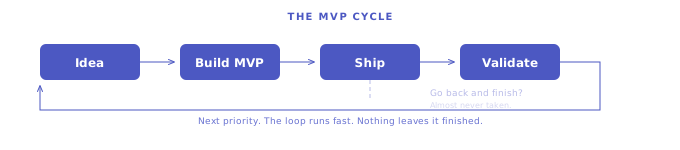
The original concept behind the Minimum Viable Product was sound: construct the smallest experiment to test a core hypothesis, gather feedback from real users, and iterate based on evidence.
In practice, “minimum viable” became the default quality bar for production software. Teams shipped MVPs as learning vehicles, metrics appeared acceptable, and organizations moved to the next priority without returning to refine what they launched.
This approach was historically rational. Validation was expensive, and building fully realized features required months of engineering. Investing three months of development in an unproven feature carried high downside risk. Testing rough versions allowed teams to manage capacity constraints.
That approach carried a compounding cost.
The cost nobody tracked
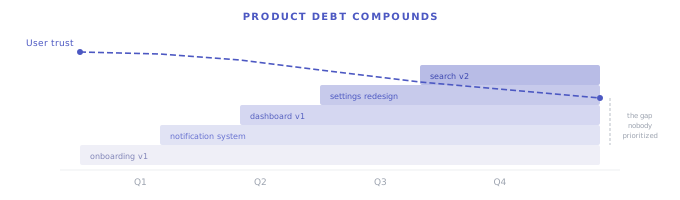
Product debt describes the accumulated weight of features that function without delivering a cohesive experience. While technical debt creates architectural friction that slows future development, product debt silently erodes user confidence.
Technical debt accounts for more than a quarter of IT budgets across over half of surveyed enterprises. Engineering teams spend weeks navigating the rough edges of unfinished predecessors.
Beyond direct operational costs, product debt degrades user trust.
Users experience product debt through daily friction: delayed notifications, ambiguous settings, or workflows requiring unnecessary steps.
Over time, these friction points define how users perceive the product. The tool feels functional but unrefined. Users remain until an alternative emerges, rarely advocating for the software.
What actually changed
Two structural shifts occurred simultaneously through AI-assisted workflows, altering different stages of product delivery.
Building became substantially cheaper, including validation artifacts. AI-assisted development compresses the implementation cycle. Stanford research indicates AI generates code 30 to 40% faster. Prototyping tools generate interactive mockups from descriptions, allowing teams to test realistic interfaces with users before writing production code. Creating test artifacts that previously required weeks now takes hours.
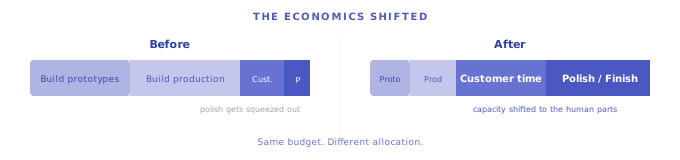
Building test vehicles is fast, but customer validation remains deliberate human work. Observing user behavior and understanding unarticulated needs takes time. AI compresses the construction around that process. Reduced implementation overhead allows product teams to spend more time directly with users, deepening qualitative research and building stronger conviction.
The original MVP trade-off relied on constrained capacity: organizations built minimal prototypes because full builds were cost-prohibitive. When rapid implementation frees time for customer research, teams validate assumptions earlier and with higher fidelity.
The historical trade-off between breadth and depth shifts as implementation costs drop. Teams can test concepts quickly, build conviction through user research, and invest recovered capacity into well-crafted production releases.
Speed is the new baseline
When the broader industry adopts AI development tools, velocity becomes standard infrastructure. Fast shipping alone no longer provides a competitive advantage.
Hubert Palan, CEO of Productboard, noted: “The reason most products struggle is not lack of shipping speed. Agents help teams ship faster than ever. The challenge is ensuring teams build the right solutions.”
Consultancies and market research echo this shift: users benchmark software against the highest-fidelity experiences available, and rapid iteration is now expected.
With speed standardized, execution quality and product craft serve as primary differentiators.
Quality produces measurable commercial results. Stripe refined the typography, layout, and imagery of a single email and recorded a 20% increase in product conversion. Their checkout flow, refined over fourteen years, increases business revenue by an average of 11.9%. Linear scaled to a $1.25 billion valuation in project management software with $35,000 in total marketing spend, relying on product execution to drive growth.
The companies already operating this way
Several organizations recognized this dynamic early, structuring their workflows around product quality.
Linear organizes dedicated polishing cycles where the team pauses new feature development to refine existing workflows. CEO Karri Saarinen describes this as quality-driven development, treating baseline execution as the primary marketing mechanism.
Stripe operationalized quality reviews through cross-functional product audits. Teams evaluate core user journeys end-to-end, maintaining friction logs and reviewing quality metrics quarterly. Former design head Katie Dill defined craft as the rigor and mastery invested during creation, with quality as the tangible output.
Airbnb restructured its product organization to support direct attention to detail. Leadership reduced organizational layers, focused on opinionated releases, and prioritized curated experiences over continuous multivariate testing.
These organizations demonstrate that deliberate attention to product quality operates effectively at commercial scale.
What this means for how we build
The objective is compressing boilerplate, validation, and scaffolding with AI, then directing recovered time toward interaction design, edge cases, and systemic consistency.
Industry analysis indicates that AI development tools enable teams to construct functional, refined interfaces in timelines previously required for wireframes alone. This creates opportunities to elevate release standards across the board.
Speed and craft reinforce each other. AI provides velocity; leadership determines whether that capacity fuels higher feature volume or higher feature completion.
In my own workflow, building an interface prototype with live data and responsive layouts previously required a week of manual implementation. AI tooling completed the structural scaffolding in a day, allowing the remaining time to focus on micro-interactions, realistic edge-case testing, and intentional UI transitions.
Recovered bandwidth allows teams to deliver polished work without compromising project schedules.
The principle underneath
AI removes the resource excuse for unfinished software.
The historical constraint was engineering bandwidth. With rapid prototyping and automated code generation, organizations have the capacity to build thoroughly. The central question is whether leadership allocates that capacity toward volume or toward craft.
In Part 2: Craft Is a Leadership Decision, I explore why faster tools do not automatically produce better products, the organizational conditions required for quality, and how teams maintain high standards under delivery pressure.
Sources and further reading:
- Soren Kaplan, “AI Means You Don’t Need a Minimum Viable Product,” Inc. (Nov 2025)
- Hubert Palan, “Product Craft When AI Changes the Stakes,” Productboard Blog
- Karri Saarinen, “10 Rules for Crafting Products That Stand Out,” Figma Blog
- Katie Dill, “How Stripe Crafts Quality Products,” Creator Economy
- Brian Chesky, Config keynote, Figma Blog
- “Taste Is the New Bottleneck,” Designative (Feb 2026)
- Aakash Gupta, “The Complete Guide to Product Craft in the AI Era,” Product Growth
- Linear polishing seasons, Michael Goitein / Substack