Product/ ·3 min read
Craft Is a Leadership Decision, Not a Resource Problem
Product Craft /Product Strategy /AI /Leadership
This is Part 2. Part 1: Put Craft Back Into the Center examines how AI altered product development economics. This piece explores why quality improvements require explicit organizational governance.
AI tooling removes the capacity constraint for unfinished products. However, increased capacity does not automatically elevate release quality.
The Jevons Paradox in economics observes that increased efficiency in coal engines led to greater total coal consumption rather than resource conservation. Lower operating costs expanded demand, absorbing efficiency gains into sheer volume.
A similar dynamic occurs in AI-assisted development. Teams that previously shipped five unpolished features per quarter often expand velocity to ship fifteen unpolished features. Tooling advances increase output volume while baseline quality remains unchanged.
Product quality has rarely been constrained by tooling alone; it is determined by organizational incentives.
The pressure paradox
When engineering velocity increases through AI tooling, organizations face a structural tension.
Initial productivity gains create an opportunity to polish core workflows, address product debt, and refine interaction details. Teams recognize the potential to resolve long-standing friction in onboarding, settings, and dashboards.
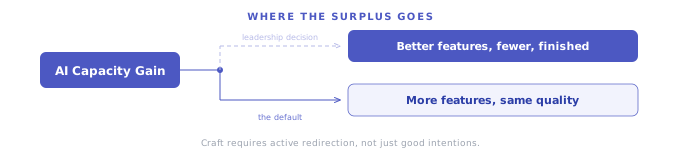
However, organizational incentives often interpret increased velocity as an invitation to expand roadmap scope.
The recovered capacity is absorbed by additional commitments. The delivery pace accelerates while the quality bar remains static.
This outcome reflects standard incentive structures that measure feature delivery volume rather than finished product performance.
Why craft does not happen by default
Three organizational factors reinforce volume over polish:
Incentive alignment. Product organizations typically reward new feature launches more visibly than the maintenance and refinement of existing workflows. Launch announcements and feature milestones receive executive attention, while interface refinement remains largely invisible.
Planning horizons. Quarterly planning cycles favor scope expansion. Committing bandwidth to refine features shipped in prior quarters can feel organizationally difficult, conflicting with forward roadmap momentum.
Measurement gaps. Product organizations track throughput, adoption, and lagging satisfaction scores. Few frameworks provide continuous visibility into interaction quality or product debt before user trust degrades.
AI amplification makes these incentives more consequential: expanding production capacity increases the importance of deliberate roadmap curation.
This is the default outcome
Historical productivity cycles demonstrate that efficiency gains tend to expand scope unless managed deliberately. Agile workflows frequently optimized for sprint velocity over iterative depth, and automated deployment pipelines increased release volume rather than release refinement.
Marty Cagan notes that discovery, rather than delivery throughput, remains the primary constraint in product development. Accelerating delivery without strong discovery mechanisms amplifies feature factory patterns.
Without explicit governance, faster development tools amplify existing volume incentives.
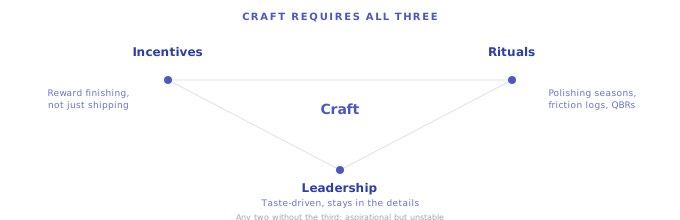
Organizations that maintain high quality standards, such as Linear, Stripe, and Airbnb, treat craft as an explicit operational discipline.
Linear schedules dedicated polishing cycles, pausing new feature work to refine shipped interfaces. Leadership allocates roadmap capacity because cohesive quality compounds over time.
Stripe manages product quality through friction logs and structured quarterly business reviews, establishing concrete accountability across core user journeys.
Airbnb reorganized its product structure to enable direct leadership involvement in design details and opinionated feature releases.
Each represents an operational governance choice rather than a tooling upgrade.
The mechanism: conviction enables craft
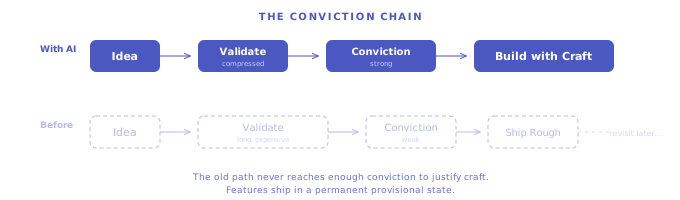
The relationship between AI and product quality operates through a specific sequence:
AI accelerates prototyping, expanding customer research time. Rapid mockup generation and interface scaffolding reduce desk-bound build time, allowing product teams to spend more time observing and listening to users.
Direct user observation builds conviction. Deep qualitative exposure gives teams the confidence needed to make definitive product bets based on verified problems.
Conviction enables investment in craft. Teams polish features when they are certain those features will endure. Rough releases often stem from strategic uncertainty. When teams possess high conviction, they commit the necessary effort to refine interactions, error states, and typography.
Persistent documentation and context layers preserve design intent across organizational transitions, ensuring teams can complete initiatives with the original context intact.
What choosing craft looks like in practice
Implementing craft requires concrete operational habits:
Polishing cycles. Scheduling regular periods dedicated to refining existing functionality.
Quality reviews. Conducting structured friction logs and user journey walkthroughs to evaluate interaction standards.
Completion standards. Ensuring features meet full documentation, edge-case coverage, and design standards before initiating new roadmap items.
Roadmap curation. Limiting scope to features that the team can execute thoroughly.
Quality metrics. Tracking friction logs and journey completion to make product health visible.
The honest version of the argument
AI tooling lowers the cost of building, placing product craft within reach for every team.
Historical constraints centered on engineering bandwidth. AI removes that limitation, but quality still requires taste, discipline, and organizational support.
Teams that prioritize feature volume risk shipping superficial software, while teams that focus recovered capacity on execution quality build durable competitive advantages.
The capacity exists. Allocating that capacity is an executive decision.
Sources and further reading:
- Marty Cagan, “Inspired” and SVPG on discovery vs. delivery, svpg.com
- John Cutler on the feature factory problem, cutlefish.substack.com
- Guillermo Rauch on “exposure hours” and taste, Lenny’s Newsletter
- Dan Luu on tooling vs. organizational incentives, danluu.com
- Salvatore Tirabassi, “Move Fast and Build Things,” Substack
- “Why AI Is Exposing Design’s Craft Crisis,” UX Collective
- CTO Magazine on tech debt costs, ctomagazine.com
- Katie Dill on MVQP and Stripe’s quality practices, Lenny’s Newsletter