XING Social Interactions
/ Product Design / Cross-Platform Plugin / B2C
Context & Challenge
Company Context
XING is Germany’s leading professional network. The company strategy that year was focused on making networking a central part of the platform again, with explicit goals to increase daily, weekly and monthly active users. Social interactions were a key lever for this, but the platform’s infrastructure was working against the goal.
Over the years, XING had grown with multiple teams building independent products that functioned autonomously. This decentralized approach led to the development of various systems for handling social interactions, many of which looked similar but behaved differently.
The Problem
Across four products (Startpage, News, Klartext, Groups), each team maintained its own implementation of social features with its own codebase. The fragmentation was both visual and functional: inconsistent iconography, different sizing, different flows. A share on the Startpage felt completely different from a share in News, even when both targeted the same channel like Chat. Users had no preview of how shared content would appear. For a professional network where users are often in a business role, this inconsistency eroded confidence. People needed to feel safe when interacting on XING, and the UI was not giving them that.
Each team maintaining its own codebase also meant that shipping improvements was slow and costly. Adding an additional channel required implementation work across all four products independently.
Challenges
- Inconsistent user experience across platforms and products: different iconography, sizing, flows
- Users lacked confidence in social interactions due to missing previews and unpredictable behavior
- Each product team maintained its own codebase, making improvements slow and expensive
- Adding a new channel required separate implementation in each product
- No shared data infrastructure to measure contribution health across products
- Company strategy demanded increased engagement (DAU/WAU/MAU) but the infrastructure could not support it efficiently
Goals
- Unify social interactions across all products into a single, consistent system
- Increase user engagement and contributions in line with the company’s networking strategy
- Enable simultaneous feature rollouts across all platforms
- Free product teams from maintaining social feature code so they could focus on their content
- Establish cross-product contribution monitoring for the first time
Discovery & Research
Research Methods
I started with a comprehensive UX audit, evaluating existing social features (comment sections, buttons, flows) using heuristic principles to identify inconsistencies and usability issues across all four products. This was followed by user interviews and behavioral analysis to understand user needs, motivations and pain points within social interactions. We also benchmarked against industry standards (Facebook, WhatsApp, Slack, LinkedIn, Twitter) because our users were not only on XING. They used these platforms daily, and their expectations were shaped by those experiences.
Key Findings
Finding 1: The Participation Pyramid. XING’s user base followed a classic 90/9/1 participation inequality pattern:
- 90% were lurkers (passive consumers)
- 9% were intermittent contributors
- 1% were heavy contributors
These groups are not independent. Power users create the content that lurkers consume, and they want to see resonance for their contributions. Lurkers provide that resonance through reactions and engagement. Both groups depend on each other. This insight shaped the engagement ladder strategy.
Finding 2: Contextual Roles. Users differentiated between professional and private interactions, requiring context-aware features. The design needed to respect the professional setting while encouraging participation. On a professional network, the bar for feeling safe enough to interact is higher than on a general social platform.
Finding 3: Safety & Transparency. Users needed clarity on visibility and immediate feedback to feel safe and in control when contributing content. Missing share previews and inconsistent behavior across products directly undermined this confidence.
Competitive Analysis
I explored interaction patterns across Facebook, WhatsApp, Slack, LinkedIn and Twitter to understand different approaches to comment input behavior, content handling and scalability across varied content types. The engagement ladder concept (progressing users from low-friction reactions to medium-friction comments to higher-friction original posts) was one key insight from this broader research that directly shaped the design strategy.
Design Process
Strategic Direction
Before a product team existed for this, I drove an internal investigation that mapped the fragmentation problem and its impact across the platform. One of our key recommendations was a unified social plugin: a single shared implementation that would replace all four codebases. The consuming product teams could then focus on their content, not on maintaining social functions. A product team was formed around this recommendation.
The participation pyramid insight drove the design strategy: design for the whole system, not one segment. Power users need tools like mentions, hashtags and threaded replies to create valuable content. But they also need to see that their content resonates, which requires lurkers to engage with low-friction reactions. Lowering the barrier for the 90% directly benefits the 1%, and giving the 1% better tools gives the 90% something worth reacting to.
Design Decisions
Decision 1: Unified Plugin Architecture Rather than redesigning each product’s social features independently, I advocated for a single plugin that could be deployed across all products. The alternative was shared guidelines with separate implementations, but that would have preserved the maintenance burden and made simultaneous rollouts impossible. The plugin approach meant product teams could stop maintaining social feature code entirely and focus on their core content. This ensured consistency while enabling simultaneous feature rollouts.
Decision 2: Progressive Disclosure in Comment Input I designed the comment input with multiple states: inactive, active MVP, active with full features, mention mode, hashtag mode. Each reveals functionality progressively as the user engages deeper. This kept the default state simple for casual users while making power features discoverable for heavy contributors.
Decision 3: Engagement Ladder The engagement ladder described how users move up or down the interaction spectrum. We needed all features (liking, commenting, posting) working together to make social interactions better on XING:
- Liking (Low Friction): The easiest entry point with intuitive UI and timely notifications.
- Commenting (Medium Friction): Increased commenting by showcasing contact comments and using engaging placeholder text.
- Posting (Higher Friction): Encouraged content creation through clear prompts and community support.
This was not a phased rollout timeline but a design framework for how different interaction types serve different user segments within the participation pyramid.
System & Pattern Thinking
I designed a reusable product pattern for the comment input experience across iOS, Android, web and mobile web. This involved a strong focus on leveraging and extending existing design system components, and introducing new global product patterns to ensure consistency and scalability across all XING platforms.
Solution
Overview
A unified social interaction plugin deployed across all XING products, replacing four fragmented implementations with a single, consistent system for liking, commenting and sharing.
Unified Interaction Bar
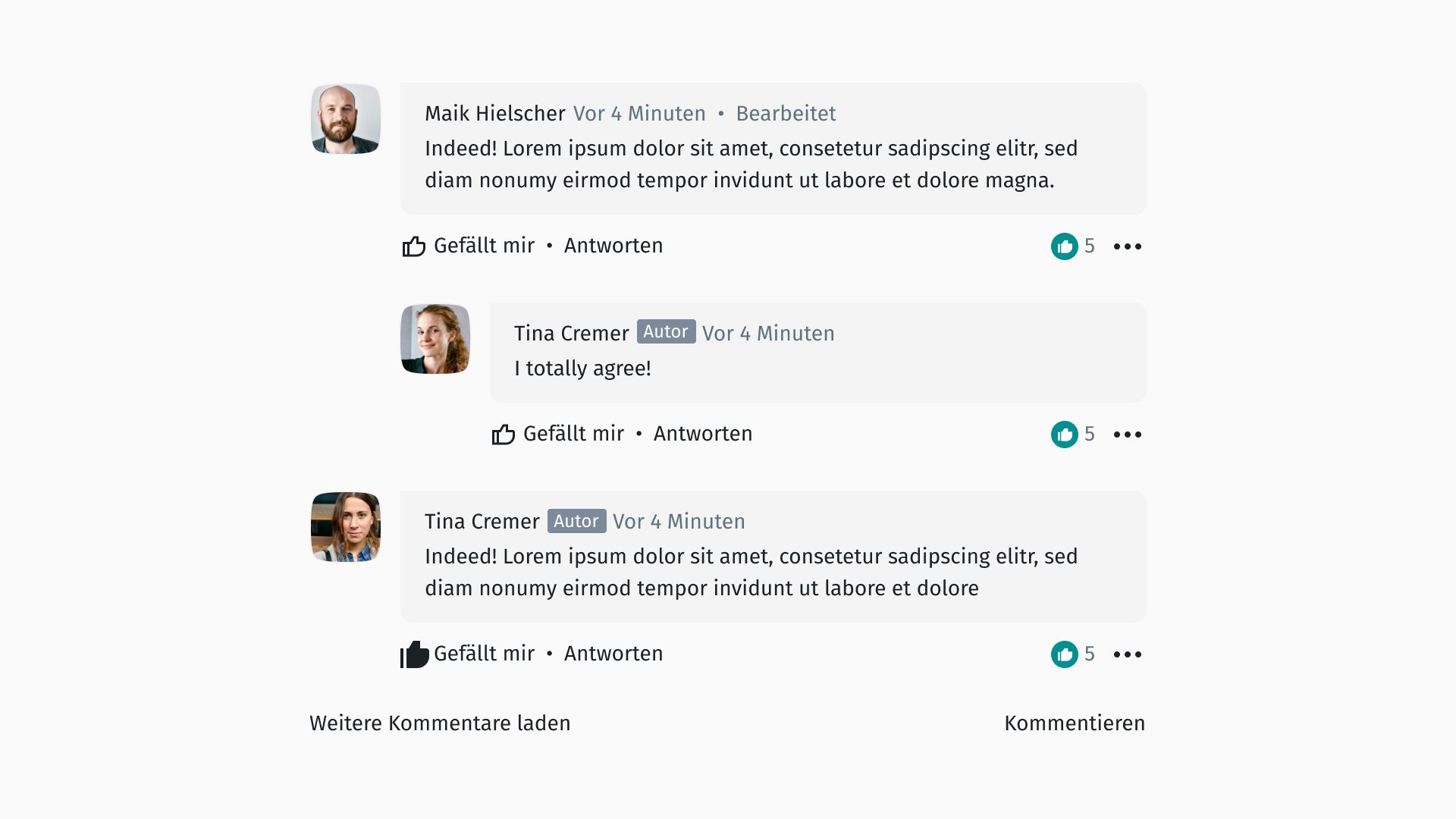
A single interaction bar for liking, commenting and sharing, replacing four implementations with inconsistent iconography, sizing and flows. Clear display of likes and comments provides social proof and encourages interaction.
Confident Contribution
Improved comment submission experience to increase user confidence and participation. Progressive disclosure ensures the input never feels overwhelming. The MVP state shows just the text field and submit button, while full features (character count, mentions, hashtags, attachments) reveal as needed. Share previews show users exactly how their content will appear before posting, addressing the safety and transparency finding from research.
Structured Discussions
Enabled threaded conversations with comment replies, fostering deeper engagement. Users can reply to specific comments, creating structured discussions rather than flat comment lists.
Direct Interaction
Facilitated user-to-user engagement by implementing @mentions to tag and involve users. The mention picker surfaces contacts contextually, making it easy to pull people into conversations.
Implementation & Iteration
MVP & Phasing Strategy
We launched the unified plugin on Startpage first because it had the highest user traffic and therefore the fastest validation cycles. This let us test with the most data before rolling out to other products.
Goals of the MVP:
- Validate without regression: Ensure no product suffered from the transition to the shared plugin. Engagement needed to stay steady or improve.
- Establish the first cross-product dataset: For the first time, we could measure social interaction metrics across products in a unified way, since data had previously been fragmented across teams.
- Build the infrastructure for enhancement: Once the baseline was stable, we could ship improvements (threaded replies, mentions, social proof elements) simultaneously to all products.
After MVP validation, we expanded with threaded replies and mentions. The unified infrastructure enabled efficient deployment of these features across all products.
Collaboration & Alignment
I was the sole designer on the product team but needed to align with designers across all consuming products. I established regular updates in our company-wide UX meetings so everybody knew exactly what was coming, what had changed and what to expect. This cross-product communication role was similar to what I had already built through XING’s notification system, which made me a natural fit for this project.
Post-Launch Iteration
Social proof elements (visible engagement counts, contact-comment highlighting) were added based on behavioral data showing their effectiveness at converting lurkers. Users responded positively: we received feedback like “finally that feature is here,” confirming that the consolidation was delivering features people had been waiting for across products.
Outcomes & Impact
| Metric | Result |
|---|---|
| User contributions | +10% increase over 6 months |
| System consolidation | 4 separate implementations → 1 unified plugin |
| Feature deployment | Simultaneous cross-platform rollouts enabled |
| Maintenance | Product teams freed from social feature legacy code |
Measurement context: Data had previously been fragmented across product teams, so there was no clean cross-product baseline before this project. What we could measure: no product suffered during the transition, engagement remained steady during consolidation, and trended upward as we enhanced features. We validated on Startpage first (highest traffic, fastest feedback). The +10% contribution increase was measured against the first complete cross-product dataset that the unification made possible.
“When sharing links on XING, I get a much better preview. This gives me confidence!”
“I can now share posts on XING beyond my network and build additional reach!”
“Finally that feature is here.”
Users responded to the consistency and the new capabilities. The share preview directly addressed the safety concern from research: users could see exactly how their content would appear before committing.
Organizational Impact
The other product teams integrated the social plugin and were relieved to stop maintaining legacy social feature code. They could focus on their content and product-specific features instead. I became the recognized domain expert for social interactions within the company, a role that built on the cross-product infrastructure position I had already established through the notification system. The project demonstrated that a shared plugin approach could work at XING, setting a precedent for how the company thought about cross-product infrastructure.
Learnings
The participation pyramid insight shaped the strategy, but the harder lesson was about unification itself. To build the single plugin, we first had to cut functionality from individual products and consolidate everything into one solution before making it customizable again. That created real friction with product teams who temporarily lost features they had owned. Alignment took longer than expected, and getting the whole thing moving required sustained advocacy across teams.
If I approached this again, I would push for first-level interactions that are product-specific from the start. Let each product pick a high-level interaction that matters most to them, so they feel ownership within the shared system rather than losing control to it. The “one size then customize” approach works technically, but the “customize from day one within shared constraints” approach works better organizationally.
The other learning I carry forward: building for one segment of the participation pyramid benefits the other. The +10% contribution increase came from serving the full loop, not from picking a side. But proving that required the cross-product data infrastructure that only existed because we unified first.